Showing posts with label heroes. Show all posts
Showing posts with label heroes. Show all posts
Tuesday, May 1, 2007


Sunday, April 29, 2007
Spiderman : The Alien Costume

Spiderman : The Alien Costume
[In the Secret-Wars] Spider-Man found himself on a satellite in a galexy far from Earth. Along with other super heroes, such as Captain America, and super villains, including Dr. Doom, Spidey was brought to the satellite by a near-omnipotent being called the Beyonder. The Beyonder wanted heroes and villains to fight a war on a planet called Battleworld. [There] Spider-Man fought many battles and his costume was left in tatters then he found a machine that could replace ruined clothing. SPider-Man triggered the clothing machine and a round black object sprang from it. It immediately started to spread up Spidey's arm, and didn't stop until it covered his entire body.
After defeating the villains and escaping the Beyonder, the heroes returned to Earth, and Spider-Man took his alien costume with him. The alien costume always seemed to know what Peter wanted, sometimes even before he did. He learned that his new supersuit was capable of generating a seemingly endless supply of webbing, and that it could also change its appearance at will. Peter and his alien costume were always in some kind of psychic contact, even when physically seperated. If the costume was in a different room, it came [slithered] at Peter's summons. [However] each night while Peter slept, the alien costume secretly slipped over him and took the unconscious Spider-Man wall-crawling at night. The web-swinger awoke each morning with no memory of his nocturnal adventures. All he knew was that he felt more exhausted before he had gone to bed.
As Peter's fatigue continued to grow he slept through the entire day and began to have terrible nightmares. So Spider-Man went to Reed Richards (Mr. Fantastic of the Fantastic Four) for help. After an exhaustive series of tests, Mr. Fantastic made a startling pronouncement. Instead of an amazing suit made of some unknown extraterrestrial fabric, Spidey's new costume was actually a living creature. It was a sentient symbiote who had formed a mental and physical bond with the Web-Slinger.
As soon as the symbiote's secret was revealed, it attempted to permanently graft itself to SPider-Man's body. Spider-Man did all he could to escape from the costume, but the symbiote tightened its grip on him, almost crushing Spidey in the process. Luckily ,Reed Richards had discovered that the symbiote was vulnerable to certain sound frequencies. Using theses sound waves, Richards managed to seperate Spidey from the costume. At last our hero was free and the alien was imprisoned.
Later, [during a power failure] the symbiote escaped from the laboratory and pounced on the unsuspecting Spider-Man. In desperation, SPider-Man lured the alien to the bell tower of Our Lady of Saints Church. He knew that the sound of the bells could free him from the symbiote. The alien, knowing that only one of them could survive the ordeal, sacrificed itself to save Peter. [Rid of the old costume Spider-Man went back to his old look.] The Black Cat, however, thought the black costume was sexier [so] she made a cloth version of it as a gift for Spidey. He used both costumes for many months and didn't get rid of his black one until Venom entered his life.
Spiderman : Costumes

Spiderman : Costumes
If clothes make the man, a distinctive costume is a definite must for a budding young super-hero. Of course, Peter Parker didn't intend to be a crime fighter when he first gained his amazing powers - he wanted to go into show business, and he needed an exciting look to match his stage act. Peter learned thatMidtown High's dance class was throwing out some old bodysuits. Slipping into the school after dark, he found one that fit him, took it to the art room, and spent a few hours silkscreening a web pattern on the shirts. He also made a skin tight pair of gloves and boots, and with some one way mirrors he found in the drama class's old prop box, he now had a mask. His first spider-costume was finally ready.
Having the perfect costume is one thing, keeping it is another matter. Peter Parker and his trusty sewing needle have spent many hours repairing the numerous rips and tears his costume has received in battle. Aunt May also contributed to Pete's costume woes. She once found his costume behind the bookcase where he had hidden it. Though Peter claimed it was for a practical joke on his friends, she refused to return it. He was forced to buy a Spider-Man suit from a local costume shop. The imitation was so cheap that it began to shrink and come apart during one of his many conflicts.
Spider-Man's boots and gloves consist of a thin layer of material so that they do not inhibit his ability to stick to walls. Spidey can [also] see out through his white eyepieces, but no one can see in. Running from his elbows to his waist, Spidey's underarm webbing is made of a flexible nylon netting. Beneath his costume's shirt, Spider-Man wears a belt that contains his spider-signal, a miniature camera, and spare web artridges. He keeps meaning to add a change purse, but has never gotten around to it. The major disadvantage of a skintight costume is that there's no room for Peter's street clothes. He either webs them into a ball attached to his back or he leaves them behind.
Spiderman : Strength and Agility

Strength and Agility
Shortly after he was bitten by the radioactive spider that gave him his amazing powers, Peter Parker accidentally crushed a steel pipe as if it were made of paper. He was astonished to discover that he now possessed superhuman strength. Since then, Spider-Man has often told people that he has the proportional strength of a spider; but he’s actually a lot more powerful. While not as strong as the Incredible Hulk, The Mighty Thor, or The Thing, our friendly neighborhood web-slinger is able to lift almost 10 tons. He can bend a solid iron bar with his bare hands and shatter a concrete wall with a single punch. And in one, spider-powered spring, he has leapt the height of three stories, or the width of a highway.
Even more impressive than his spiderlike strength is Spider-Man’s amazing speed and agility. When it comes to quick thinking, death-defying, lightning swift, acrobatic stunts, the wall crawling wonder is truly without equal. Spider-Man moves with a fluid and casual grace that can’t even be equaled by trained superathletes such as Captain America or Daredevil. He leaps from rooftops, summersaults over flagpoles, tumbles off water towers, and balances on top of light poles as he routinely travels across the city in his own unique manner.
Average people have been known to lift cars in times of stress. Spider-Man can raise a couple of Cadillacs on a normal day. Add in the excitement of one of his typical battles, and his power level can shoot into uncharted territory. Over the years the web-slinger has been seen holding up multistory buildings, freeing himself from beneath tons of debris, and flattening cosmically powered aliens.
Spider-Man's reflexes operate up to forty times faster than those of a normal person, and he uses them to dazzle much stronger foes. Faced by the Rhino or even the Hulk, Spider-Man kicks into high gear ricocheting off the walls, ceiling, and ground to barrage his opponent with blow after blow. THe victim, dazed by the wall-crawler's speed, is left punching thin air.
Spiderman : College (Studying)
Spiderman : College
Fascinated with science ever since Uncle Ben took him to his first monster movie, Peter Parker immersed himself in his studies. Despite web swinging and a hectic social life, he was determined to be success and to make his Aunt May proud. Peter was more self confident in college than he had been in high school. Leaving home for the first time, he moved into a bachelor pad and even bought a motorcycle. Spider- Man ruined Peter's college graduation. In the week before the ceremony, Spidey was battling the Green Goblin and the Rocket Racer. He couldn't graduate with the rest of his class since he'd missed a required gym class.
Peter finally got his degree from Empire State University, but he continued his studies as a graduate student, and took a job as a teaching assistant. With all these activities, as well as being Spider- Man, Peter's life got a little too hectic. He decided he needed a rest, and he withdrew from the graduate program. Later, taking Aunt May's advice, he returned to college and continued working toward his master's degree.
Throughout his career as Spider-Man, Peter has always been torn between his sense of duty and the mixed feelings he has received from the public. This reception has varied from praise to outright condemnation, and it has left the teenager confused about his role. It has even driven him to the brink of despair, causing him to throw away his costume and renounce his alter ego. Nevertheless, his dedication to using his powers responsibly has always led to Peter donning the mask again in the hope that some day the world will learn to appreciate Spider-Man.
Spiderman : High School (Studying)
High School
Peter was an honor student, and his teachers always thought very highly of him. He always came prepared for class, and completed all of his asignments. The other students , however, had little time for a know-it-all like puny Peter. The girls thought he was too quiet, and the boys considered him a wimp. Peter was pinfully shy, and some of his classmates misinterpreted his silence for snobbery. He had trouble making friends, but never stopped trying. He often invited other students to join him at science exhibits or monster movies. But they usually responded with ridicule, and almost never asked him to join them.
May Parker insisted that peter wear glasses, but after he became Spider-Man his eyesight improved. Flash Thompson broke Peter's last pair of glasses during a shoving match, and Peter never got around to buying a new pair. Before hi gained his spider powers, Peter had considerably less than average strength for a boy of his age. Clumsy and uncoordinated, he also had no athletic ability. He had a fear of heights - even getting a book from the top shelf in the library resulted in his suffering severe symptoms of vertigo.
Peter always thought of his Uncle Ben as his best friend. Ben had an extensive collection of old comic books and science fiction magazines that he enjoyed sharing with his nephew. Peter spent hours reading these comics and their stories about outrageous heroes and their intriguing adventures. He dreamed of being a costumed adventurer like Captain America, striking terror in the hearts of criminals.
Peter Parker graduated from Midtown High with the highest scholastic average in the school's history, but he almost missed the ceremony. Instead of attending to last minute graduation details, Peter was trading punches with a superhuman villain, the Molten Man. He won his fight and arrived home just in time to change for the ceremony. Later, he was thrilled to discover that he had won a full scholarship to Empire State University.
Spiderman : Peter Parker

Peter Parker
Peter Parker was only a young boy when his parents died in a plane crash. He immediately moved in with his fathers older brother and wife. Ben and Mary Parker were an elderly couple with no children of their own, and they raised Peter as if he were their son. They rarely spoke about Peter's real parents, so Peter became convinced that his parents had left him because of something he had done. Afraid of being abandoned, Peter worked hard to win his uncle's approval - though he didn't have to worry. Ben and MAry truly loved their nephew and would have done anything to please him.
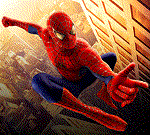
in photo : Tobey Maguire as Spiderman in the Movie
Spiderman : Amazing Fantasy (2)

Spiderman : Amazing Fantasy (2)
Continue ---
This story, with its challenge to comic book clichés, created an unexpected sensation. "A few months later," Lee recalls, "we got the sales figures, and that Spider-Man issue of Amazing Fantasy was one of the best selling books we ever had. There were no flies on us, so we put him out in his own title." However, the usual months of creative and production work leading to publication kept #1 from appearing until March 1963.
Until this time Jack Kirby had been drawing all of the company's new characters, but Spider-Man ended up in the hands of another artist. Kirby drew several pages of a version of Spider-Man, but he never completed a story. Kirby's version was as bold and dynamic as the rest of his work, but Lee wanted something a bit more offbeat and edgy. Steve Ditko was the artist to provide it, an Lee asked him to illustrate the initial Spider-Man adventure. The now famous cover for the first story was drawn by Kirby and Ditko together. "Steve Ditko was a fine artist, " says Kirby, "and he did a fine job on Spider-Man".
Born in 1927 in Johnstown, Pennsylvania, Ditko had already won a cult following with the dark moody tales he had illustrated for comic books like Amazing Adult Fantasy. An intensely private individual who shuns personal publicity and consistently refuses interviews, Ditko has always preferred to let his work speak for itself. The analogy to Peter Parker working behind the mask of Spider-Man may not be entirely inappropriate. Ditko was the perfect choice to depict the new antihero, a skinny kid who just didn't know what to do with the extraordinary gift that had unexpectedly come his way. "Steve was every bit as inventive as Jack Kirby was," says Lee. "He always added so much." As time went on, Ditko also began to contribute significantly to the plotting of the stories. From the very start, Ditko's sensitive, humanistic portrayal of the beleaguered Peter Parker was enough to alter the look of the medium forever: he brought a touch of realism into a world of fantasy.
Spiderman : Amazing Fantasy

Caught in the web
The first Spider-Man story was originally intended as no more than a one-shot experiment, and almost didn't get into print at all. "Martin Goodman didn't want to publish it," recalls Stan Lee. Goodman was convinced that readers would find the subject of spiders distasteful.
Fortunately for all concerned, a comic book called Amazing Fantasy was about to be canceled due to faltering sales. "Nobody cares what you put in a book that's going to die," Lee says, "so I threw in Spider-Man. I featured him on the cover and then forgot about him." For the occasion the comic book reverted to its original title of Amazing Fantasy, an appropriate amendment since Spider-Man was to be the most important adolescent super hero in comics.
Spider-Man was the hero and teenage helper rolled into one; he was his own sidekick. Marvel's first editor, Joe Simon, theorized that kid companions like Captain America's Bucky were important because they gave the protagonist someone to talk to; Spider-man talked to himself. In fact he has delivered more siloquies than Hamlet. In his first appearance he mused out loud but subsequently Lee adopted the device of the thought balloon with its characteristic bubbles. "I used those thought balloons to help the exposition," says Lee. "I could put interesting thoughts there that weren't necessarily about what ws happening in that particular panel - something to hold the reader's interest."
Spider-Man, despite the fact that he was not originally intended to star ina series, became the epitome of the radical innovations that characterized The Marvel Age. Lee used him to challenge the very concept of the super hero. Spider-Man was neurotic, compulsive and profoundly skeptical about the whole idea of becoming a costumed savior. The Fantastic Four argued with each other, and The Hulk and Thor had problems with their alter egos, but Spider-Man had to struggle with himself.
In the original story (August 1962), Peter Parker is a bookish, bespectacled high school student, isolated and unpopular. An orphan, he lives with his elderly relatives, Aunt May and Uncle Ben. While attending a science exhibit, Peter is bitten by a spider that has accidentally received a dose of radioactivity. As a result, Peter acquires the agility and proportionate strength of an arachnid. He sews his own super hero uniform and uses his scientific knowledge to build mechanical devices that eject sticky webbing, but he is less interested in fighting crime than in making a buck. Disguised as Spider-Man, he becomes a professional wrestler and then demonstrates his abilities on television. Hw blithely ignores the chance to stop a fleeing thief, but his indifference ironically catches up with him when the same criminal later robs and kills Uncle Ben. Eventually Spider-Man subdues the murderer, but for a tearful Peter Parker, there is no peace. He wanders remorsefully off into the night to the accompan iment of Lee's now famous caption: "With great Power there must also come - great responsibility!"
Spiderman : Comic Book
Spiderman : Comic Book
From 1982 to 1988, Spider-Man was seen around town in this black costume,but now he has returned to his true colors
Saturday, April 28, 2007
Spiderman : Profile

Spider-Man Profile
Spider-Man is the quintessential Marvel character. Although a super hero, he is spared none of the slings and arrows of ordinary life; he experiences difficulties with friends, family, sweethearts and employers. His powers enable him to do good, but not to improve his own lot in life, and it is his simple humanity, rather than his exotic talent, that has won him millions of enthusiastic fans. He is one super-hero who has not lost the common touch, and in fact he is frequently described as "your friendly neighborhood Spider-Man."
In his 1962 debut, Spider-Man took to fighting crime for a reason commonplace in comc books: he was motivated by the murder of a father figure, his Uncle Ben. Yet Spidey's driving force is guilt, not revenge; he must live forever with the knowledge that he could have prevented the killing if he had not been so self absorbed. Perhaps he suffers from a classic Oedipus complex; in any case he is certainly neurotic, forever agonizing over the choices that confront him when he attempts to do the right thing. Despite his best efforts, he is viewed with a touch of suspicion by those in authority, and is sometimes considered little more than a criminal himself.
Although nobody seems to understand him, Spider-Man has the spirit to be a joker as well as a tragic figure. He is quick with a quip, appreciates the irony of his endless predicaments, and relishes the chance to play tricks on people who never suspect that he and Peter Parker are one and the same.
As originally depicted by writer Stan Lee and artist Steve Ditko, Peter Parker was just a bit of a wimp. Bright, imaginative, but nonetheless an alienated adolescent, he might well have been a typical comic book reader. Although he has matured and gained in confidence over the years. Spidey is still all to human. He misses appointments, catches the flu when he needs to fight, forgets to put film in his camera and has trouble paying the rent. In short Spider-Man remains Everyman, "the super hero who could be you."
Spiderman : History

By 1962 , with the success of the Fantastic Four and other characters, Marvel editor and head writer Stan Lee was casting about for a new superhero idea. He said[citation needed] that the idea for Spider-Man arose from a surge in teenage demand for comic books, and the desire to create a character with which teens could identify. In his autobiography, Lee cites the non-superhuman pulp magazine crime fighter The Spider as an influence[2] and both there and in a multitude of print and video interviews said he was inspired by seeing a fly climb up a wall — adding in his autobiography that he has told that story so often he has become unsure of whether or not it is true.[3] Artist Ditko, in a 1990 article by himself, gave a more prosaic origin story for the name:
“ “In a discussion with me about Spider-Man, Stan said he liked the name Hawkman but DC had the name and character. Marvel would add Ant-Man [and the Wasp] so it would have the insect category. (Technically a spider is not an insect). From that I believed Stan had named the character.[4] ”
Lee approached Marvel publisher Martin Goodman to seek approval for the character. In a 1986 interview, he described in detail his arguments to overcome Goodman’s objections.[1a] Goodman agreed to let Lee try out Spider-Man in the upcoming fidouchenal issue of the canceled science-fiction/supernatural anthology series Amazing Adult Fantasy, which was renamed Amazing Fantasy for that single issue, #15 (Aug. 1962).[5]
Jack Kirby, in a 1982 interview, claimed Lee had minimal involvement in the character’s creation, and that it had originated with Kirby and Joe Simon, who in the 1950s had proposed a character called The Silver Spider for the Crestwood comic Black Magic until the publisher went out of business. [1a]
Simon, in his 1990 autobiography, disputes Kirby’s account, asserting that the supernatural anthology Black Magic was not a factor, and that he (Simon) devised the name “Spiderman” (later changed to “The Silver Spider”), while Kirby outlined the character’s story and powers. Simon later elaborated that his and Kirby’s character conception became the basis for Simon’s Archie Comics superhero The Fly, introduced in early 1959.
Amazing Fantasy #15 (Aug. 1962). Cover art by Jack Kirby (penciller) & Steve Ditko (inker).Comics historian Greg Theakston says that Lee, after receiving Goodman’s approval for the name Spider-Man and the “ordinary teen” concept, approached Kirby. Kirby told Lee about his 1950s Silver Spider/Spiderman, in which an orphaned boy living with an old couple finds a magic ring that gives him superpowers. Lee and Kirby “immediately sat down for a story conference” and Lee afterward directed Kirby to flesh out the character and draw some pages. Steve Ditko would be the inker.[6] “A day or two later”, Kirby showed Lee the first six pages, and, as Lee recalled, “I hated the way he was doing it. Not that he did it badly — it just wasn’t the character I wanted; it was too heroic”.[7] Simon concurs that Kirby had shown the original Spiderman version to Lee, who liked the idea and assigned Kirby to draw sample pages of the new character but disliked the results — in Simon’s description, “Captain America with cobwebs”.[1b]
Lee turned to Ditko, who developed a visual motif Lee found satisfactory, although Lee would later replace Ditko’s original cover with one penciled by Kirby. Ditko said,
“ “The Spider-Man pages Stan showed me were nothing like the (eventually) published character. In fact, the only drawings of Spider-Man were on the splash and at the end [where] Kirby had the guy leaping at you with a web gun… Anyway, the first five pages took place in the home, and the kid finds a ring and turns into Spider-Man.[8] ”
Ditko also recalled that,
“one of the first things I did was to work up a costume. A vital, visual part of the character. I had to know how he looked … before I did any breakdowns. For example: A clinging power so he wouldn’t have hard shoes or boots, a hidden wrist-shooter versus a web gun and holster, etc. … I wasn’t sure Stan would like the idea of covering the character’s face but I did it because it hid an obviously boyish face. It would also add mystery to the character….”
Much earlier, in a rare contemporaneous account, Ditko described his and Lee’s contributions in a mail interview with Gary Martin published in Comic Fan #2 (Summer 1965): “Stan Lee thought the name up. I did costume, web gimmick on wrist & spider signal”. Additionally, Ditko shared a Manhattan studio with noted fetish artist Eric Stanton, an art-school classmate who, in a 1988 interview with Theakston, recalled that although his contribution to Spider-Man was “almost nil”, he and Ditko had “worked on storyboards together and I added a few ideas. But the whole thing was created by Steve on his own… I think I added the business about the webs coming out of his hands”.
Who is Spiderman ?

Who is Spiderman ?
Spider-Man (Peter Benjamin Parker) is a fictional Marvel Comics superhero created by Stan Lee and Steve Ditko. Since his incarnation and first appearance in Amazing Fantasy #15 (Aug. 1962), he has become one of the world’s most popular, enduring and commercially successful superheroes.
When Spider-Man first saw print in the 1960s, teenage characters in superhero comic books were usually sidekicks. The Spider-Man series broke ground by featuring a hero who himself was an adolescent, to whose “self-obsessions with rejection, inadequacy, and loneliness” young readers could relate. Spider-Man has since appeared in various media including several animated and live-action television series, syndicated newspaper comic strips and a successful series of films.
Marvel has published several Spider-Man comic book series, the first being The Amazing Spider-Man. Over the years, the Peter Parker character has developed from shy high school student to troubled college student to a married teacher and a member of the superhero team the Avengers.
what is Hero ?
What is Hero ??
From the Greek in mythology and folklore, a hero (male) or heroine (female) usually fulfills the definitions of what is considered good and noble in the originating culture. Typically the willingness to sacrifice the self for the greater good is seen as the most important defining characteristic of an hero. However, in literature, particularly in tragedy, the hero may also have serious flaws which lead to their downfall, e.g. Hamlet. Such heroes are often called tragic heroes.
Sometimes a person might achieve a high enough status to become courageous in people's minds. This often leads to a rapid growth of myths around the person(s) in question, often attributing him or her with extraordinary powers.
Some social commentators prescribe the need for heroes in times of social upheaval or national self-doubt, seeing a requirement for virtuous role models, especially for the young.[citation needed] Such myth-making may have worked better in the past: current trends may confuse heroes and their hero-worship with the cult of mere celebrity.
however Hero still can happen every time, you can be Hero also.
Subscribe to:
Posts (Atom)